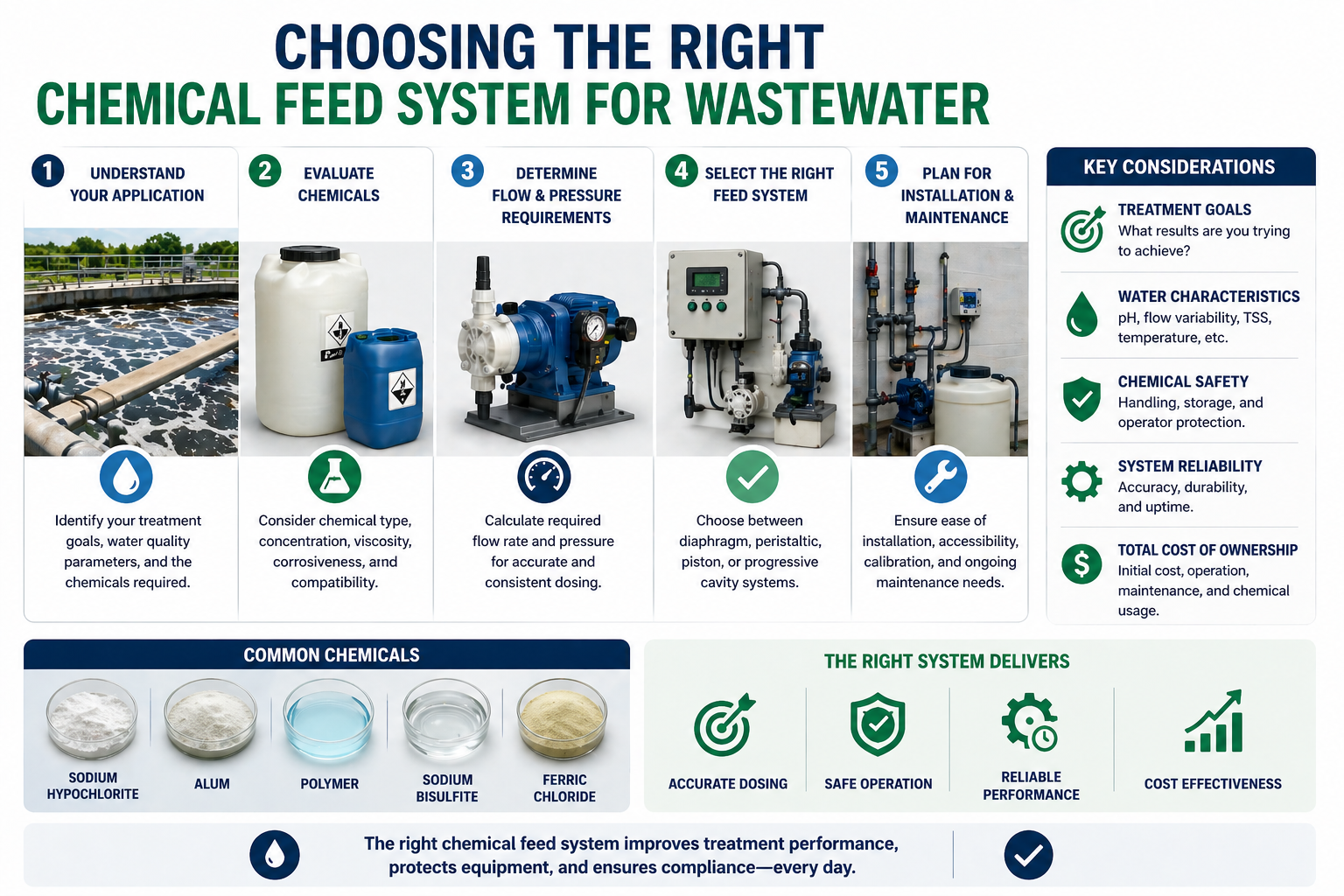
Choosing the Right Chemical Feed System for Wastewater Treatment
A chemical feed system is only as effective as the match between its design and the demands of your specific application. Too many wastewater operators end up with systems that are imprecise, maintenance-intensive, or chemically incompatible with what they’re dosing — not because the equipment was poor quality, but because it wasn’t selected with the right criteria in mind. Choosing the right chemical feed system for wastewater requires working through several key variables before a single piece of equipment is specified: what chemical you’re dosing, at what concentration, into what flow conditions, under what pressure, and with what level of control precision. At Wastewater Supply, we work with contractors, municipalities, and facilities managers across the country, and this guide walks through exactly what those variables are and how they should drive your selection.
Why Chemical Feed System Selection Matters More Than Most Operators Realize
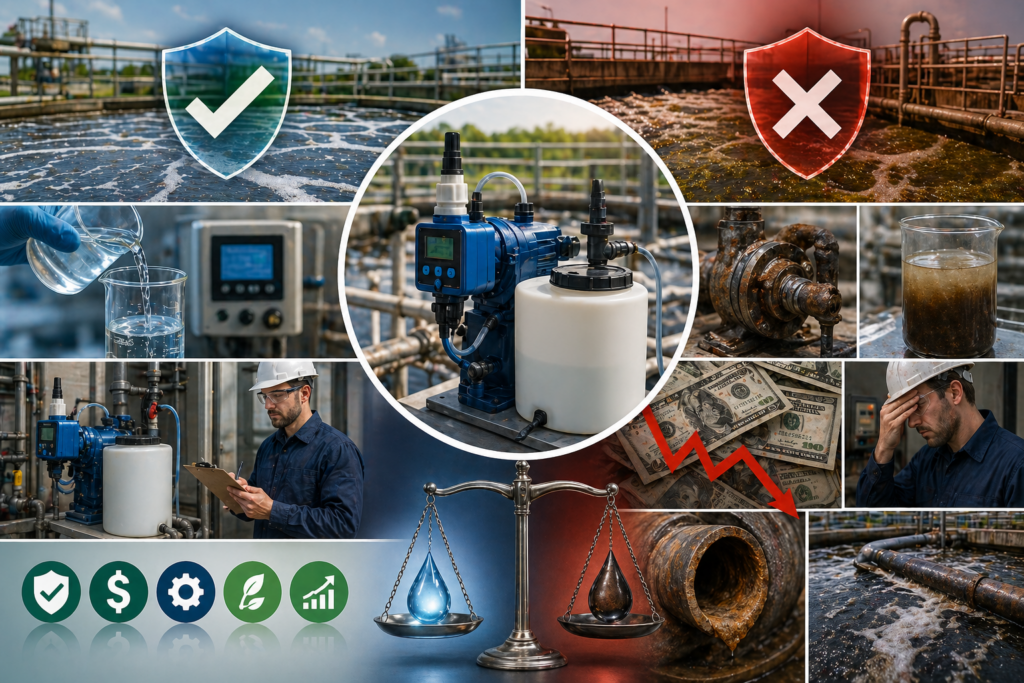
A mismatched chemical feed system creates problems that compound quickly. Under-dosing fails to achieve treatment targets — whether that’s disinfection, pH neutralization, odor control, or phosphorus removal — and can result in permit violations and water quality failures. Over-dosing wastes chemicals, increases operating costs, and can introduce its own treatment problems. A system that’s incompatible with the chemical being fed degrades rapidly, producing maintenance burden and reliability issues that cascade into system downtime.
Precision is non-negotiable in wastewater chemical feeding. Treatment chemistry has a narrow operating window, and the consequences of operating outside it — from regulatory non-compliance to infrastructure damage — make equipment selection a decision worth getting right the first time. Here’s how to approach it systematically.
Step 1: Define the Chemical and Its Physical Properties
The chemical being dosed drives nearly every downstream selection decision. Before evaluating pump types, materials, or control systems, you need a clear characterization of the chemical itself:
- Chemical identity and concentration — Sodium hypochlorite (bleach) for disinfection, ferric chloride or alum for coagulation, caustic soda for pH adjustment, polymer for sludge dewatering, sodium bisulfite for dechlorination, and hydrogen peroxide for odor control all have different handling requirements and material compatibility profiles.
- Viscosity — Low-viscosity aqueous solutions (sodium hypochlorite, for example) behave very differently in a metering pump than high-viscosity polymer solutions. High viscosity reduces the net positive suction head available to the pump and can cause starved suction conditions that compromise dosing accuracy.
- Gas-forming tendency — Sodium hypochlorite is notorious for off-gassing chlorine, which can cause vapor lock in standard diaphragm pumps and lead to loss of prime. This property alone can drive the selection toward peristaltic pumps or specialized dual-diaphragm designs that handle off-gassing chemicals without losing prime.
- Corrosiveness — Sodium hypochlorite corrodes most metals on contact. Ferric chloride and sulfuric acid are similarly aggressive. All wetted components — pump heads, check valves, tubing, injection points, and storage tank fittings — must be fabricated from materials compatible with the specific chemical being dosed.
- Solids content — Lime slurries, polymer solutions, and some coagulants contain suspended solids that can foul check valves in diaphragm pumps. Systems dosing slurried or particulate-bearing chemicals are often better served by peristaltic or progressive cavity pump designs that don’t rely on check valves for their metering action.
Step 2: Determine Your Flow Rate Range and Required Turndown Ratio
Chemical feed systems in wastewater applications rarely operate at a single steady flow rate. Influent flow varies with time of day, day of week, and seasonal patterns. The chemical dose required may also vary independently of flow — for example, a pH adjustment application that requires more acid during certain industrial discharge events regardless of plant flow.
The turndown ratio — the range between maximum and minimum operating flow rates — is one of the most commonly overlooked factors in system selection. Standard motor-driven diaphragm metering pumps operating on variable frequency drives typically provide a reliable turndown ratio of approximately 10:1. If your application demands a wider range — say, a 20:1 or 50:1 turndown between peak daily flow and minimum overnight flow — a single standard pump may not be able to cover the full range accurately. Solutions include dual-pump configurations (a high-flow and a low-flow pump running in parallel), selecting a pump type with a higher inherent turndown ratio, or using advanced control systems to manage dosing across the full operating envelope.
At minimum, specify your system based on:
- Peak flow rate — the maximum anticipated plant flow under which the system must deliver the required dose
- Minimum flow rate — the lowest flow condition under which the system must maintain accurate dosing without stalling or becoming inaccurate
- Required dose range — the span of chemical doses that may be required across the full range of operating conditions, not just the design average
Step 3: Select the Right Pump Type for Your Chemical and Application
The three pump technologies most commonly used in wastewater chemical feed systems each have distinct strengths and limitations:
Diaphragm Metering Pumps
Diaphragm pumps are the most widely used metering pump technology in wastewater treatment. A flexible diaphragm and check valves create controlled suction and discharge strokes that deliver precise, repeatable volumes. They are accurate, relatively low-cost, and available in an extremely wide range of flow rates and pressures. Their key limitations are sensitivity to gas-forming chemicals (which can cause vapor lock and loss of prime) and dependence on clean check valves — fouled check valves in a diaphragm pump result in inaccurate dosing or complete loss of prime. For clean aqueous chemicals without significant off-gassing or solids content, diaphragm pumps are typically the best combination of performance and value.
Peristaltic (Hose) Pumps
Peristaltic pumps move fluid by compressing a flexible tube or hose with rotating rollers, creating a gentle, pulsation-reduced flow without any check valves or mechanical seals in contact with the chemical. This makes them ideal for off-gassing chemicals like sodium hypochlorite, abrasive slurries, and viscous polymer solutions where check valve fouling would be a persistent problem. They are simple to maintain — the only wear component in contact with the chemical is the hose or tube — and handle a wide variety of difficult fluids effectively. The trade-off is that hose life is finite and must be monitored; a ruptured hose in a peristaltic pump releases the chemical being dosed directly into the pump housing. Modern peristaltic designs with integrated tube failure detection systems address this risk by automatically shutting down the pump and triggering an alarm on tube failure.
Progressive Cavity Pumps
Progressive cavity pumps use a helical rotor turning inside a stator to create a continuous, pulsation-free flow. They are well-suited for high-viscosity applications and slurried chemicals — polymer, lime, and similar materials — where neither diaphragm nor peristaltic pumps handle the fluid properties well. They deliver consistent flow rates regardless of discharge pressure changes, which makes them valuable in applications where system pressure variability is significant. They require more maintenance than diaphragm pumps and are generally more expensive, making them the right choice for demanding viscous-fluid applications rather than general-purpose chemical dosing.
Step 4: Specify Materials of Construction for Chemical Compatibility
Every component that contacts the chemical being dosed must be compatible with that chemical for the full range of concentrations, temperatures, and contact times your system will encounter. Material incompatibility produces equipment corrosion and degradation that contaminates the treatment system, introduces maintenance costs, and can cause catastrophic system failures.
Key compatibility considerations by chemical type:
| Chemical | Compatible Wetted Materials | Materials to Avoid |
|---|---|---|
| Sodium hypochlorite (bleach) | PVC, PVDF, PTFE, Viton, ceramic | Most metals, stainless steel at high concentrations |
| Ferric chloride | PVC, PVDF, PTFE, Hastelloy C | Carbon steel, stainless steel, most metals |
| Caustic soda (sodium hydroxide) | PVC, polypropylene, PTFE, stainless steel (low concentrations) | Aluminum, zinc, copper |
| Sulfuric acid | PVC, PVDF, PTFE, Hastelloy C (concentrated); stainless 316 (dilute) | Carbon steel, most metals at high concentrations |
| Polymer solutions | Stainless steel, PVC, polypropylene | Materials that promote biological growth at low flow points |
| Sodium bisulfite | PVC, PVDF, Viton, stainless steel 316 | Carbon steel, copper alloys |
This table covers common materials — always verify compatibility for your specific chemical concentration and operating temperature with the chemical manufacturer or a compatibility reference guide before finalizing specifications.
Step 5: Design the Right Control Strategy for Your Application
How a chemical feed system is controlled determines how accurately it maintains the intended dose under real operating conditions. Three primary control strategies are used in wastewater applications:
- Manual control — The operator sets a fixed pump output based on expected conditions. Simple and low-cost, but provides no automatic response to changes in flow or chemistry. Appropriate only for stable, low-variability applications where conditions don’t change significantly.
- Flow-paced control — The pump speed is proportional to the plant flow rate measured by an influent flow meter. As flow increases, the pump output increases automatically to maintain the desired dose in mg/L. This is the most common control strategy for flow-dependent applications like disinfection and coagulant feeding. It requires a reliable flow meter signal and a pump capable of responding to variable-speed control.
- Compound-loop (feedback) control — Flow pacing is combined with real-time process feedback from an analyzer — a pH meter, chlorine residual analyzer, or turbidity sensor — that continuously trims the pump output up or down to maintain a specific process setpoint. This is the most precise and responsive control strategy, appropriate for tight effluent quality requirements or where influent chemistry is highly variable. It requires both a flow meter and a process analyzer, along with a control system capable of integrating both signals.
For most small-to-medium wastewater systems, flow-paced control provides the best balance of accuracy and simplicity. Larger facilities or those with stringent effluent limits typically benefit from compound-loop control for at least their disinfection and pH-critical chemical feeds.
Step 6: Account for Pressure and System Hydraulics
Diaphragm and plunger-type metering pumps require a positive pressure differential between suction and discharge to seat their check valves correctly. If the discharge point is at atmospheric pressure — such as an open channel — and the suction tank is at a higher elevation, the system can allow chemical to siphon through the pump uncontrolled rather than being metered by the pump’s stroke action. A backpressure valve installed on the discharge line creates the artificial restriction needed to ensure accurate metering and prevent siphoning.
Similarly, all positive-displacement pumps — including diaphragm and progressive cavity types — require pressure relief protection. Because these pumps will continue to build pressure against a closed or blocked discharge valve until something ruptures, a properly rated and routed pressure relief valve is a mandatory safety component of any chemical feed system. Relief valve discharge must be routed back to the supply tank or to a safe collection point — never to atmosphere where chemical could create a hazard.
Step 7: Plan for Calibration, Maintenance, and Spare Parts
A chemical feed system that can’t be verified and maintained accurately is a liability rather than an asset. Every chemical feed installation should include a calibration column — a graduated cylinder installed on the suction line that allows operators to verify actual pump output by directly measuring drawdown volume over time. Calibration should be performed at commissioning and at regular intervals during operation, and whenever pump components are replaced.
Maintenance planning should account for:
- Diaphragm replacement intervals (varies by chemical aggressiveness and duty cycle)
- Check valve inspection and cleaning frequency (particularly for chemicals with solids or crystallization tendency)
- Hose or tube replacement schedule for peristaltic pumps
- Injection quill inspection for plugging or corrosion at the point of chemical introduction
- Storage tank inspection and cleaning schedules
Stocking critical spare parts — diaphragms, check valve balls and seats, tubing, injection quills — at the facility eliminates the downtime associated with waiting on replacement parts when a component fails during operation.
At Wastewater Supply, we stock a full range of chemical feed components — metering pumps, chemical storage tanks, control panels, injection accessories, and system hardware — to support chemical feed systems of all types and scales. If you’re specifying a new system or replacing aging equipment, our team is available to help you match the right components to your application. Contact us at (317) 674-3812 or reach out at [email protected].
Frequently Asked Questions: Choosing a Chemical Feed System for Wastewater
What is the most common type of pump used in wastewater chemical feed systems?
Diaphragm metering pumps are the most widely used in wastewater applications due to their accuracy, broad operating range, and relatively low cost. They perform well across most common wastewater chemicals when properly specified for chemical compatibility. Peristaltic pumps are the preferred alternative for off-gassing chemicals like sodium hypochlorite and for slurried or particulate-bearing fluids where check valve fouling would be a recurring issue with diaphragm designs.
How do I size a chemical metering pump for my application?
Sizing requires converting your process parameters — plant flow in million gallons per day (MGD) and required dose in mg/L — into volumetric pump output in gallons per hour (GPH) or milliliters per minute. The standard calculation is: lbs/day of active chemical = Flow (MGD) × Dose (mg/L) × 8.34. That active chemical quantity then needs to be converted to a solution volume using the chemical’s concentration and specific gravity. Pump sizing should be done at both peak and minimum operating conditions to confirm the selected pump covers the full required turndown range accurately.
Can I use the same chemical feed system for different chemicals?
In most cases, no — or not without thoroughly flushing and potentially replacing wetted components between chemicals. Different chemicals have different material compatibility profiles, and a pump head or valve assembly that is suitable for one chemical may be rapidly degraded by another. Dedicated chemical feed systems for each chemical being dosed are the standard approach in wastewater treatment. Attempting to share equipment between incompatible chemicals creates both safety and reliability risks.
What maintenance does a chemical feed system require?
Routine maintenance for diaphragm pump systems includes regular check valve inspection and cleaning, diaphragm inspection and replacement at manufacturer-specified intervals, injection quill inspection, calibration verification, and storage tank inspection. Peristaltic pump systems require periodic hose or tube replacement and roller inspection. All systems require regular calibration checks to confirm actual output matches the intended dose. Maintenance frequency depends on duty cycle, chemical aggressiveness, and the specific equipment — consult the manufacturer’s maintenance manual for interval recommendations specific to your pump model and application.
What safety components are required in a chemical feed system?
At minimum, every positive-displacement chemical feed system requires a pressure relief valve sized and routed to handle the maximum pump output safely, and a backpressure valve on the discharge line to ensure accurate metering and prevent siphoning. Chemical containment around storage tanks and pump skids, appropriate secondary containment for the volume of chemical stored, adequate ventilation for off-gassing chemicals, and personal protective equipment (PPE) provisions for operators performing maintenance are additional safety requirements. Specific regulatory requirements for secondary containment and ventilation vary by chemical type and jurisdiction.